power transmission lines
Power Transmission Lines
In Power systems, transmission lines are the arteries for the power network. There are billions of kilometers of transmission lines in power system in the world. These networks, sometimes by substation to the internal network connect to other countries that form a network which is known to infinite networks.
For example, Iran's internal power network is connected to Iraq, Armenia and Turkmenistan. Here I am going to tell you a summary of the technical subject's power transmission lines that I hope you like!!!
Alternating current circuits, when energized, create electromagnetic and electro static field about the conductors. This alternating field in turn creates two impedances in circuit. The electromagnetic field creates impedance that is called inductive reactance while the created by the electrostatic field is called capacitive reactance. The reactance tend to balance of the circuit. In a 3phase transmission lines these model is shown as π-model.
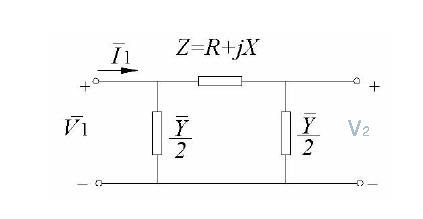
π-model in transmission lines
Transmission lines made of two basic parts with include:
1-electrical parts
2-mechanical parts
Electrical parts
Electrical devices in transmission lines include: conductors, guard wire, insulator, spacer, damper, arcing horn, corona ring and (sometime) lighting arrester.
Of course all these devices may be a transmission line is not.
Mechanical parts
Tower and Hardwar's are important in mechanical parts in transmission lines that hardware include: Suspension Clamp, Turn Buckle, Yoke Plate, Socket-Clevis, Socket-Eye, Clevis-Eye, Clevis-Ball, Eye-Ball, Extension Link, Shackle, Chain, U-Bolt, Dead End Clamp, Jumper Terminal, Conductor Joint, Repair Sleeve , Tower Bonding Clamp, amour rod,….
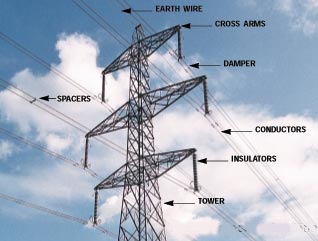
Structures tower
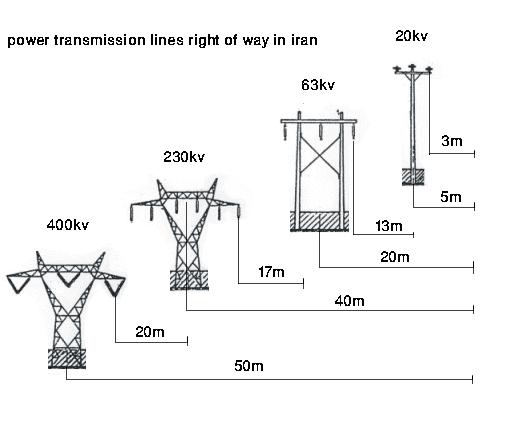
Towers are generally fabricated of galvanized steel members, mostly of angle iron but including other shapes, bolted or riveted together, and in some case welded together, their height may vary from some 15 to 50 meter, depending on the voltage of the transmission line and the minimum standards of distances of the lowest conductor at the lowest point of sag to the ground and clearances between conductors, in accordance with the national electric safety code.
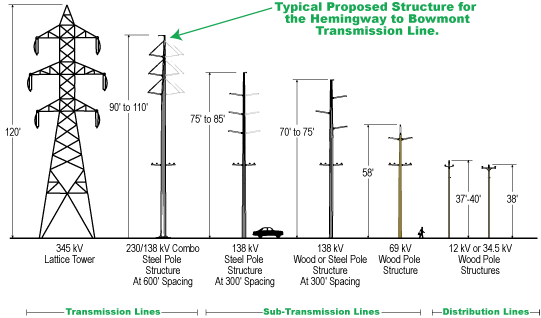
Height of towers that vary depending voltage, tower and… (The voltage levels are supposition)
The framework nature of the structure minimizes the effect of wind and generally provides a means of access for the worker, although steps are sometimes is provided. The tower footings are attached to sister members imbedded in concrete pilings for short, light towers and in concrete foundations for the larger, heavier duty towers multiple bolts or rivets are used, again depending on the forces they must sustain. There are several types of towers, each designed its purposes that including: suspension type, angle type and dead end type towers.
Suspension or tangent types are towers in which the insulators to which the conductors are attached are free to swing. The spans on either side of the insulator string approximately even so that the structure carries only the weight of the conductors, ice coated, and the force of the wind against them.
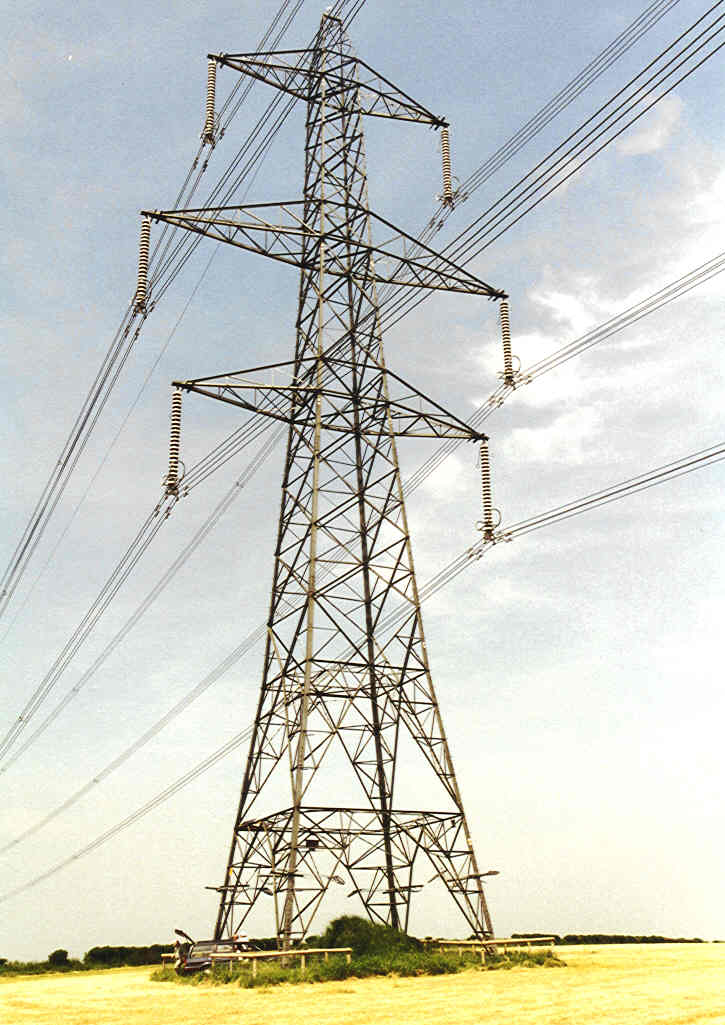
Angle or corner type towers are designed to hold the spans of conductors on either side that are at an angle with each other. They are usually also of dead end design. These towers are of great strength, and may also be guyed to take care of the forces due to the uneven balance of conductors attached to the cross arm on the tower
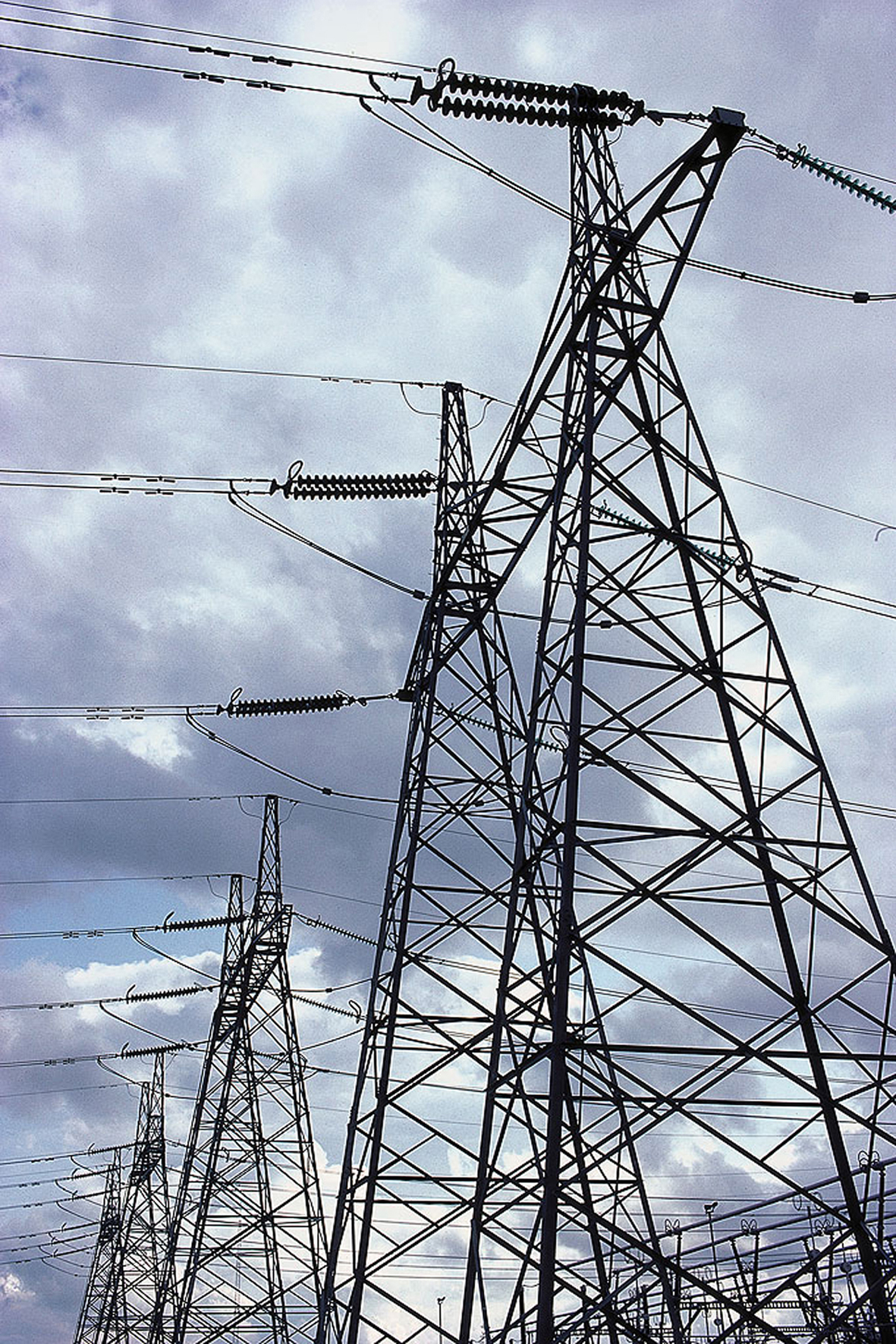
.
Angle type tower
Dead end type towers also carry the weight of the span of conductor, but the spans may be unequal in length and the spans on either side are dead ended, each mounted through the insulators directly to the cross arm attached to the tower. The strength of this type is greater than that of the suspension tower.
Conductors:
Conductors on transmission lines are usually made of aluminum or their alloys with reinforced steel core that commonly called ACSR
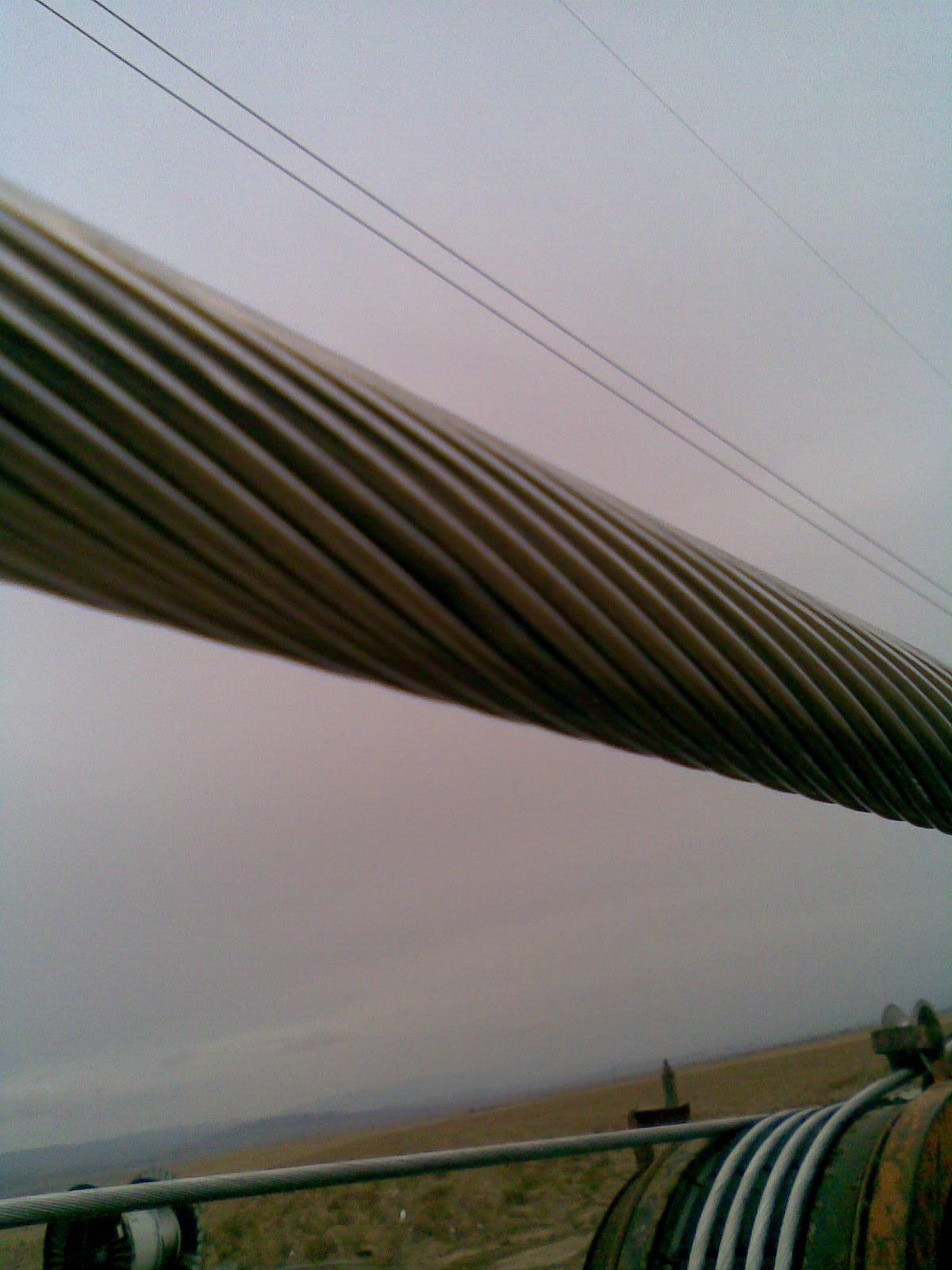
.
Since because skin effect utmost the current pass in conductor surface, be removed the central part and reinforce by steel strands for increasing their assiduity, to mechanical stress.
Shield wire:
The shield or Guard wire usually makes be of steel strands. As the name implies the shield wire functions protect of conductors, insulators and other devices in substation witch connected to they, against lighting and itinerant wave.
This wire is placed over the conductors at a height to from a 30-degree angle (from experience and tests).in that case, two (or more) such wires need to be installed, these wires are solidly grounded at each structure where they are supported, this connection includes all other points of ground on the structure, including the ground of the circuit or circuits themselves. Also in new lines uses of opgw wire for shield wire (Optical fiber guard wire). It use for communication between substation and protecting the line against lighting
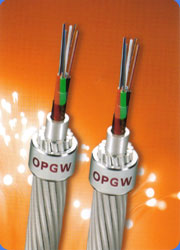
.
Insulators
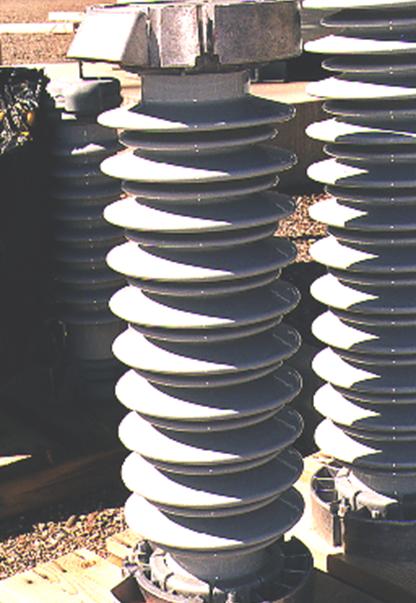
Generally insulators in power electric industrial are as supports for bare energized devices. In transmission lines, insulators have this function too.
They come in two popular shapes discs and posts. Both consist of units that are capable of being added in strings for discs and columns or posts to achieve the desired amount of insulation.
They are made of porcelain and glass and polymer (plastic). Other insulator may be found as supports for buses, on disconnecting switches and as bushings on circuit breakers, transformers and other devices.
All are subject to accumulations of dirt (and salt in seaside areas), and are subject to cleansing during rain storms. All are subject to accumulation of ice and show that tends to shorten the insulating path of the insulator an aid in the flashover of the from nearby lighting strokes and switching surges.
The other important problem causes of insulator surface pollution, is a little current that flow in insulators surface that know “creeping current”. This current causes increasing loss in power network.
Also the number of insulators is easier way to find the line nominal voltage. For example in 63kv 4 or 5 discs insulators exist. And 132kv 8 or 9, 400kv 22 or more exist.
Also during utilization of transmission or substations, the insulators must be under the maintenance regular program. Damages or destructions of several discs in a chain that might be occur for them, including: fracture (causes vandals or sabotages), puncture (causes flashover or lighting) and serious dirty that apiece must be obviating for prevention of incidence fault
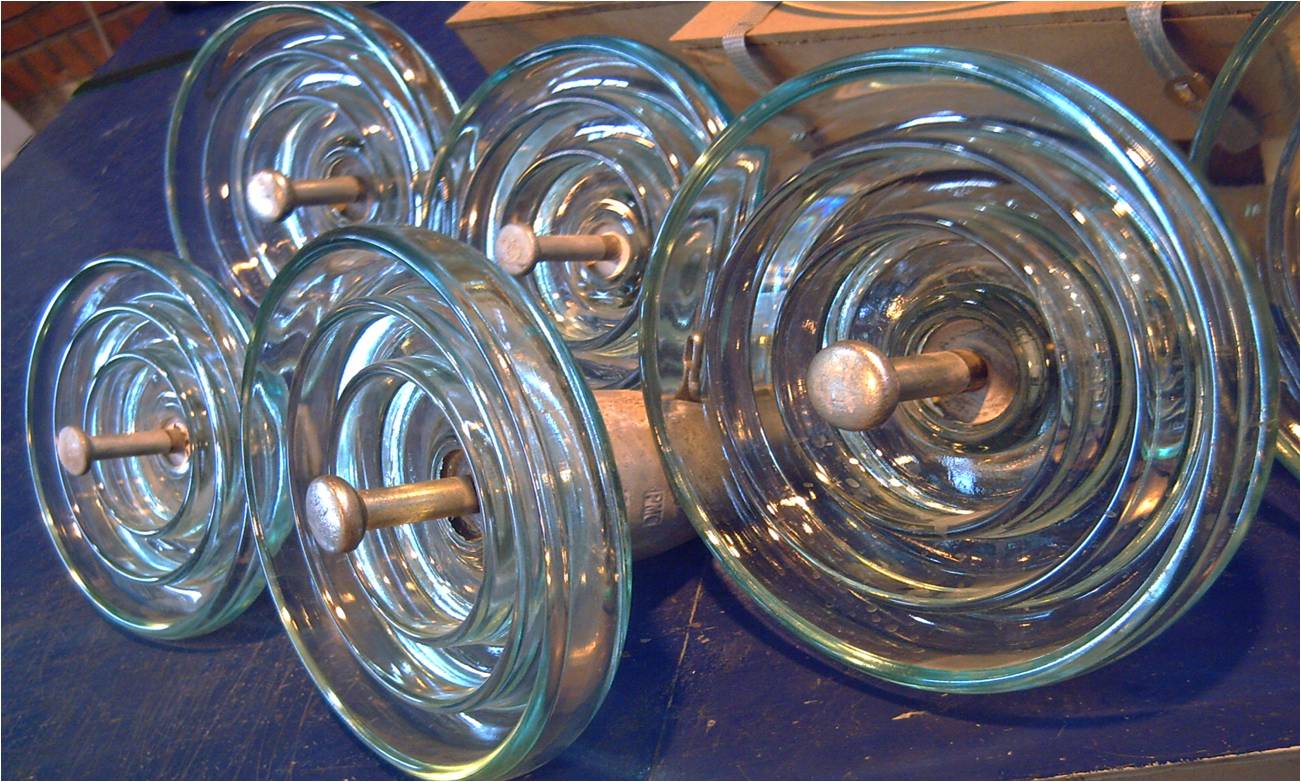
Spacer
Spacers use in bundle lines that by installing a second or more conductors (depending to the power and voltage and line distance) alongside the original one by means of hardware designed for such purposes.
Damper
There are 3 type vibrations in transmission lines conductors that including: 1- Aeolian 2- galloping 3- wake induced
Aeolian vibrations have high frequency and low magnitude and galloping is vibrations with low frequency and high magnitude.
Also wake is irregular vibrations causes wind and gale.
Aeolian and wake induced vibration in lines causes' pendulous bendy stress and causes in final rupture and exhaustion in conductors.
Also galloping causes be damage in conductors in timing about 1 to 48 hours
.
Lighting obviation devices
The devices that use in transmission lines, for preventing of hurt to the power network devices causing of lighting including: guard wire and lighting arrester.
Lighting arresters are installed at strategic locations on the transmission lines, usually some three or four spans apart. Their ground wire is connected to the overhead ground and to the steel structure on tower lines and to copper wires alongside the wooden structure to grounds in the earth or counterpoise where they exist.
Also for prevention of damage to insulators we use arcing horn or arcing ring (corona ring).arcing horn is typical lighting arrester for keep flash away from insulators.
Right of way
There are obviously many items in this category from rights-of-way.
The right of way over witch a transmission line is located depends largely on the type of line and the nature of the terrain. In general it should be wide enough so that adjacent trees or other structures, in falling, do not encumber the space under the conductors,
 با سلام و درود فراوان